

 18 December 2025
 CONGENITAL PROBLEMS
 0 Comments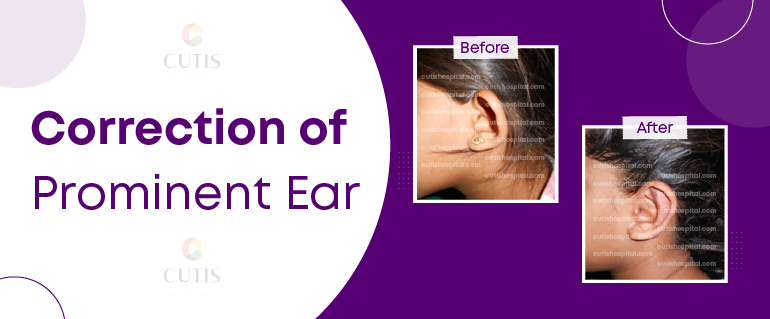
We all have seen children with different birth defects involving the face, limbs, genitals, or other parts of the body. These defects can range from something as simple as an extra finger to more complex deformities involving the entire face and skull, which are called craniofacial anomalies. While complex abnormalities naturally raise concern and may cause functional problems, even smaller-looking birth defects can deeply affect a child’s psychology.
In today’s world of social media, selfies, and mobile photography, children have become increasingly aware of their appearance and how others see them. Prominent ear (bat ear) is one such facial deformity where early and timely correction is extremely helpful for both the patient and the plastic surgeon.
Why Early Correction Matters
Prominent ear correction is done by placing sutures at precise, pre-marked points inside the ear cartilage. When these sutures are placed correctly, they mold the ear into a normal, desired shape. If the molded ear is protected with a bandage encircling both ears around the head for about 3 weeks after surgery, the new shape is usually retained for a lifetime.
Children have soft and pliable cartilage, which makes molding easier. As age increases, this pliability decreases, and it becomes more difficult for the plastic surgeon to place sutures and mold the ear. In adolescents and adults, the cartilage is more rigid and has a memory property, so even after correction it may unfold and return to its original shape.
In children below 10 years of age, recurrence after surgery is rare.
Prominent ear deformity is visible from birth but becomes a noticeable concern when the child starts going to school and begins comparing themselves with peers. Since hearing is usually normal in these children, parents may miss this subtle issue. Even today, many families visit a plastic surgeon only when the child becomes an adult—often around marriageable age—unaware that every birth defect has an ideal age for correction.
The same applies to prominent ear. When corrective surgery (otoplasty) is performed between 7 and 10 years of age, the results are most desirable and the chances of long-term retention of the corrected shape are highest.
Case Study: 8-Year-Old Girl with Prominent Ear Deformity
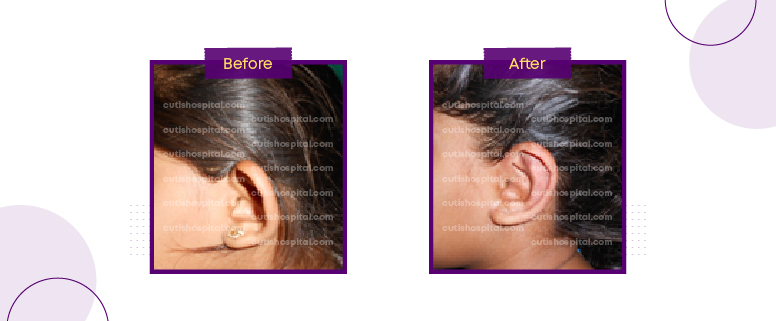
Recently, an 8-year-old girl visited us with her parents for correction of prominent ear deformity on both sides. Fortunately, she came at exactly the right time to receive maximum benefit from the operation. We planned simultaneous correction of both ears under general anesthesia.
The surgery was performed through an incision behind the ear (on the posteromedial surface), which is not visible in normal day-to-day life. The abnormal ear cartilage was dissected, molded into a normal shape, marked, and fixed with permanent stitches to retain the new contour. Each ear was corrected one after the other, ensuring symmetry on both sides.
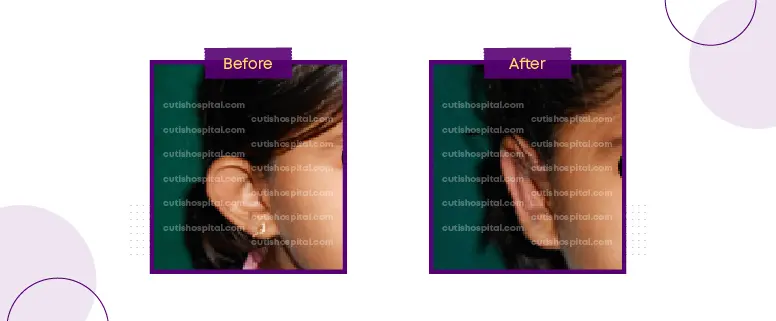
The surgical incisions were carefully closed without disturbing the newly molded shape. A protective bandage was applied over both ears, encircling the head around the forehead. The patient was advised to keep this bandage on for at least 14 days after surgery.
This procedure does not leave any visible scar, and the results are striking and appreciated by all.
Conclusion
To achieve the best results in the treatment of prominent ear deformities or protruding ears, children should be treated at a young age, ideally prior to the age when the cartilage begins to harden and lose its flexibility. Surgical correction of the ears, performed at a young age, not only restores normal ear shape, but also helps to build a child's self-esteem and confidence as they progress through their formative years in school and other social environments.
If you are a parent who is concerned about your child's protruding ears, and wish to find out what the best surgical option and time for the surgery will be, you should contact Cutis Hospital in Ahmedabad. Parents should seek medical advice and information about when is the best time to pursue medical intervention for their child's protruding ears. Early medical intervention will provide parents with the most accurate information regarding the treatment of their child's ears, as well as help them achieve an optimal outcome based on the needs of their child.
Frequently Asked Questions
It is a facial deformity noticeable from birth where the ear appears more protruded than normal.
Because children have soft and pliable ear cartilage, which makes molding easier and helps retain the new shape permanently.
Between 7 to 10 years, as mentioned in the content.
By placing sutures at precise, pre-marked points inside the cartilage of the ear to mold it into a normal shape.
A protective bandage around the head must be maintained for 14 days to 3 weeks, as per the content.
No. The incision is made behind the ear, on the posteromedial surface, which is not visible in normal situations.
Recurrence is rare in children below 10 years, but in adolescents and adults the cartilage may unfold due to rigidity and memory.
Because the child’s hearing is normal and parents often miss the subtle deformity until adulthood or marriageable age.

